
INSIGHTS / RISK MANAGEMENT
Whaling Emails: Fraud Prevention and Linguistic Indicators
Risk Management
Context
Whaling attacks are a highly targeted form of business email compromise designed to induce employees to perform unauthorized actions by impersonating senior executives. Beyond technical deception, these schemes rely heavily on linguistic manipulation and contextual credibility.
Understanding how whaling emails are constructed is therefore a critical component of fraud prevention, particularly for organizations operating in complex or hierarchical decision-making environments.
Analysis
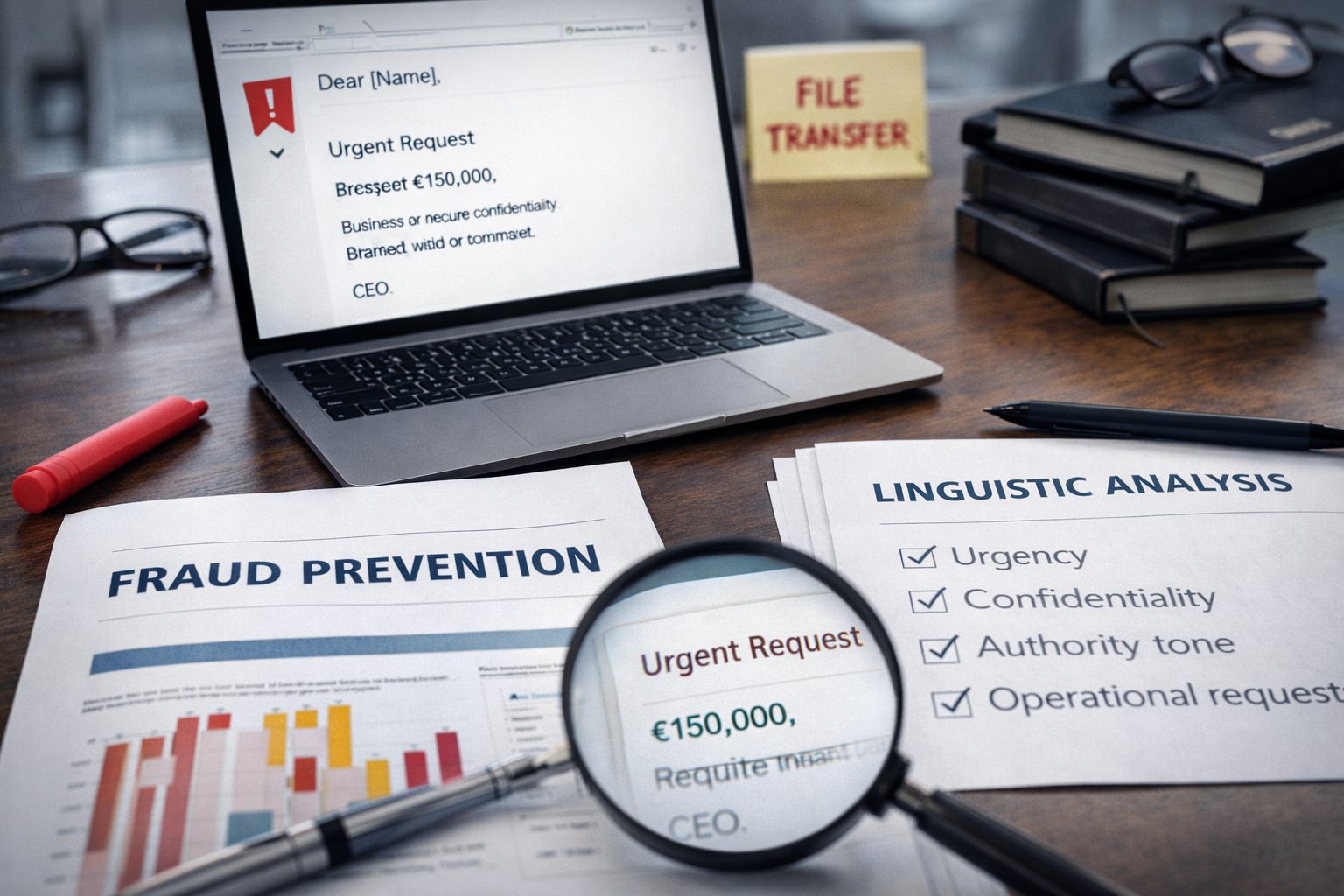
Unlike generic phishing messages, whaling emails are usually crafted to resemble legitimate executive communications. They often adopt a concise, authoritative tone and leverage organizational familiarity rather than overtly suspicious elements.
Common characteristics observed in whaling messages include:
references to confidential or sensitive matters, used to discourage verification;
expressions of urgency or exceptional circumstances, aimed at bypassing standard controls;
language consistent with executive style, including brevity, decisiveness, and implicit authority;
requests that appear operationally plausible within the recipient’s role and responsibilities.
From a fraud prevention perspective, the effectiveness of these messages lies in their alignment with internal communication norms. The closer the message adheres to expected linguistic and stylistic patterns, the lower the likelihood that it will be immediately questioned.
This makes detection difficult if prevention relies solely on individual awareness. Linguistic cues are subtle and often insufficient on their own to trigger suspicion, especially in organizations where speed and compliance with senior requests are culturally reinforced.
Implications for Organizations
Whaling highlights the limits of employee vigilance when not supported by robust organizational controls. While awareness training remains essential, it cannot compensate for weak or informal processes.
Effective prevention requires a combination of:
formalized verification procedures for sensitive requests, regardless of the sender’s apparent seniority;
segregation of duties and approval thresholds for financial and strategic actions;
clear escalation channels that legitimize verification without reputational or hierarchical pressure;
periodic review of internal communication practices to reduce predictability and misuse.
From a governance standpoint, whaling emails exploit structural behaviors rather than technical gaps. Organizations that equate authority with immediacy or discourage questioning are inherently more exposed to this form of fraud.
Key Takeaway
Whaling emails rely on linguistic credibility and organizational context, not just deception.
Executive tone, urgency, and confidentiality are central manipulation tools.
Employee awareness is necessary but insufficient without formal controls.
Fraud prevention must integrate linguistic risk, process design, and governance culture.
Source
This Insight is based on a high-level analysis of publicly available commentary on whaling attacks and employee responsibility, originally published by RiskCompliance. (link)
The content has been independently summarized and restructured for analytical and informational purposes.